

Carer Forklift: paper handling means engineering the process
Heavy loads, confined spaces and a product that leaves no room for error: in paper handling, power and precision must go hand in hand. Carer responds with a high-capacity electric range and solutions engineered around the actual workflows of paper mills and logistics operators, from reel handling to battery autonomy, with the goal of ensuring control, operational continuity and efficiency.
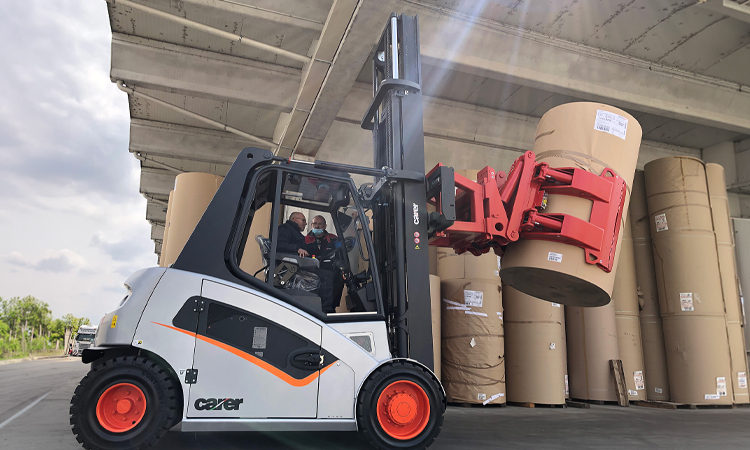
In the paper industry, handling is not measured in tonnes alone. A reel can weigh more than four tonnes, take up significant space and require high-level storage. But the real challenge lies elsewhere: it must be moved without affecting its geometry, surface or quality. This creates a clear requirement, one that concerns the forklift as much as the process itself.
The truck needs lifting capacity, of course. But it must also ensure precision in load handling, smooth movements, operator visibility and full control throughout every stage of the cycle. Acceleration, braking, clamp pressure and mast stability become process variables, not merely technical specifications.
This is where Carer has built its expertise in the paper sector, developing high-capacity electric forklifts from 5.5 to 20 t and dedicated configurations for paper mills, converters and logistics operators.
The forklift is the workflow
Every facility has its own layout, production pace and storage logic. Reels vary in weight, diameter and height; shifts can be more or less intensive; manoeuvring space is often limited. That is why choosing the right model is only the first step. The A 55-60-70 SC series combines lifting capacity and manoeuvrability, while the Z 60-80 H² is designed to handle heavy loads in confined spaces and at high lift heights. For more demanding applications and outdoor operations, the AX series comes into play; for higher capacities and intensive duty cycles, the range also includes the A 160/1200 S.
What really makes the difference, however, is the way the truck is engineered around the application. Through its SPED, Special Engineering Department, Carer analyses the operating cycle as a whole: layout, loads, lift heights, handling systems, operating times, environmental conditions and shift organisation. This analysis can lead to dedicated solutions involving the chassis, mast, cabin, hydraulics or attachments.
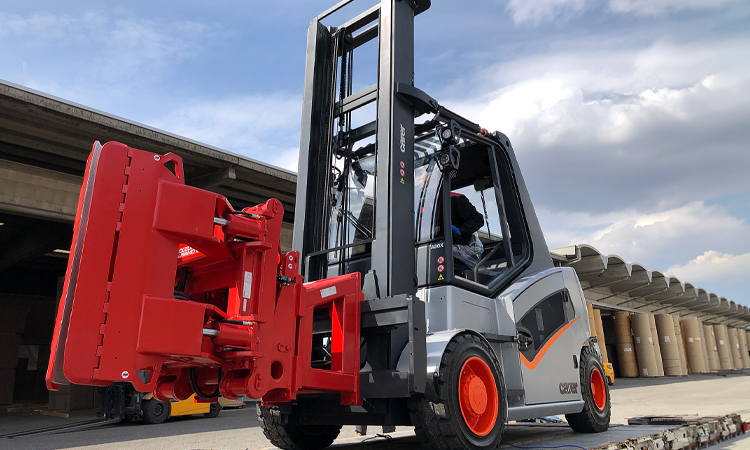
In paper handling, one of the key issues is clamp management. The grip must be secure, but never excessive: enough force to control the reel, enough sensitivity to avoid deforming it. The operator station can also be adapted to improve visibility and control during pickup, transfer and storage.
The same applies to truck response. Traction and hydraulics must deliver progressive acceleration, controlled braking and smooth movements, reducing stress on the reel and making manoeuvres easier in tighter spaces. Battery capacity and charging systems must also be sized according to the actual duty cycle, reducing downtime and ensuring operational continuity.
In this context, electric powertrains are particularly well suited to indoor environments: zero tailpipe emissions, lower noise levels and cleaner working areas. These are advantages that improve both workplace quality and product protection. Carer’s experience across different markets and operating conditions, from continuous duty cycles in Nordic countries to Italian applications involving large paper reels, triplex masts, LFP batteries and dedicated handling systems, points to one simple principle: the forklift must be engineered around the process, not the other way around.
Do you have a handling requirement in the paper industry? Every industrial application calls for a specific solution. Contact the Carer team to learn more and identify the configuration best suited to your company’s needs. Write to info@carerforklift.com
Tags: paper mills, paper sector